MURDER BETWEEN THE LINES, By Radha Vatsal
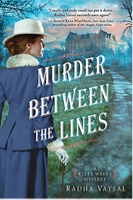 In her second Kitty Weeks novel, Radha Vatsal again takes us back to the 1910s, a tumultuous time in U.S. history, where women are demanding the long promised right to vote, and, as World War I bloodies Europe, the American government and defense industries are quietly preparing for war.
Set in 1915, New York City, "Murder Between the Lines," depicts an America that, on the surface, appears to be as it has been for decades. Kitty Weeks, the daughter of a wealthy man who simultaneously tries to protect her as he encourages her to be independent, knows that war is coming. The signs are not hidden well. Her best friend returns from nursing soldiers on the battlefields of Europe a broken woman. She has seen the horror of trench warfare first hand. At the same time, former President Theodore Roosevelt has "called for a navy that would be second in size and efficiency only to that of Great Britain," and government money is pouring in to test Edison's batteries for use in submarines.
A writer for the ladies' page of "The Sentinel" newspaper, Kitty has pushed hard against covering tea parties and has successfully convinced her editor to allow her to cover suffragettes and Woodrow Wilson's visit to New York City. When Elspeth Bright, a young, vibrant woman, connected to the Edison battery-research, is found frozen to death in Central Park, Kitty is driven to use her journalist skills to try to bring her justice.
Vatsal's meticulous historical research broadens Kitty's world to include the famous suffragette, Alva Belmont (also known as Alva Vanderbilt), and the actress Marie Dressler, known later for, among other things, her brilliant performance in "Dinner at Eight." We also attend the "first annual dinner of the Motion Picture Board of Trade of America" at the newish Waldorf-Astoria. Here, President Woodrow Wilson prophetically states: “America will always seek to the last point at which her honor is involved to avoid the things which disturb the peace of the world, ...there will come that day when the world will say, ‘This America that we thought was full of a multitude of contrary counsels now speaks with the great volume of the heart’s accord, and that great heart of America has behind it the supreme moral force of righteousness and hope and the liberty of mankind!'”
Radha Vatsal is an exceptional writer and gifted historian. In the first Kitty Weeks novel, "The Front Page Affair," and again in this second novel, Vatsal has successfully recreated the mood, the sights, smells and controversies of New York City in the years leading up to the deployment of American soldiers to fight in the Great War. As the United States enters into the centennial anniversary of America's involvement in that war, Vatsal's books allow us to reflect on the small fires that led to the conflagration, and they allow us to recognize that the fight for female equality is not a recent endeavor.
"Murder Between the Lines" deserves more than five stars. Read it and you will agree.
Print Length: 320 pages
Publisher: Sourcebooks Landmark (May 2, 2017)
Publication Date: May 2, 2017
Sold by: Amazon Digital Services LLC
*A virtual blog tour is underway where six book bloggers, including me, post clues provided by Radha Vatsal to a mystery involving President Wilson's 1915, wedding. Click here to read clue number four, and to find links to other five clues.*
THE FRONT PAGE AFFAIR, By Vadha Vatsal
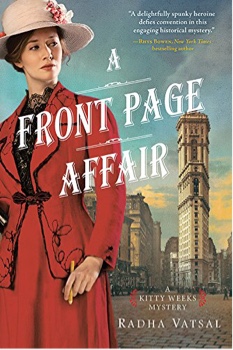 Although World War I raged in Europe starting in 1914, the United States did not declare war on Germany until April 6, 1917. As we enter into the centennial anniversary of America's involvement in that war, historical novels, such as Radha Vatsal's excellent, debut novel, "The Front Page Affair," provide clear and insightful glimpses into the tension-filled and fearful miasmas that permeated New York City in the years preceding 1917.
Specifically, Ms. Vatsal recreates the 1915, New York City world of Kitty Weeks, a wealthy young woman who has traveled the world with her cosmopolitan father. Although she is considered from the "wrong side of town," (at least, according to Kitty's debutante friend), Weeks is a well educated, modern woman.
Constrained by the social mores of the time, Kitty is prohibited from covering news stories, and instead she is forced to write for the Ladies' Page of one of the many New York City newspapers. Born abroad, raised in Europe and educated in Switzerland, Kitty struggles to find her niche. After stumbling upon a murder while covering her first society event, she finds herself enmeshed in what may be an espionage scandal that has major implications for America's continued neutrality concerning the war with Germany.
It is very rare to find a debut novel so well written and so engrossing. "The Front Page Affair" is on a par with the Maisie Dobbs novels of Jacqueline Winspear. More than that, Ms. Vatsal clearly understands the importance of creating an historical novel that transforms 1915 from a dusty, ancient year in America's past, to a vibrant and dangerous time not unlike our own.
* Print Length: 338 pages
* Publisher: Sourcebooks Landmark (May 3, 2016)
* Publication Date: May 3, 2016
* Sold by: Amazon Digital Services LLC
Radha Vatsal is the author of two highly rated historical novels set in New York City during the years leading up to America entering World War I: "The Front Page, Affair," and, "Murder Between the Lines." We have reviewed both books, above.
We asked Ms. Vatsal why she chose the years of World War I as the setting for her Kitty Weeks novels, and she graciously provided us with a guest post, found here.
*A virtual blog tour is underway where six book bloggers, including me, post clues provided by Radha Vatsal to a mystery involving President Wilson's 1915, wedding. Click here to read clue number four, and to find links to the other five clues.


 "World War I isn’t usually considered to be America’s war. The US joined the fighting late – the war began in the fall of 1914 and America joined the fray in 1917. By and large, stories about the war tend to focus on the experience “over there”—in English or French country homes, or in the battlefields of Europe. To me, it seems that we know more about World War II, in part because of that war’s atrocities and in part because it had clear good guys, Roosevelt and Churchill, and bad guys, Hitler and Stalin. World War I is more complicated. It was started by Kaiser Wilhelm--first cousin to King George of England--but was the result of military buildup that had been going on in Europe during the so-called “Belle Epoque,” a seemingly tranquil period of peace and prosperity—and the setting of many beloved period series and films. But tensions were mounting behind the scenes and when they exploded, the world changed. Empires that had ruled great swathes of the world for centuries fell: the Hapsburgs of Austria-Hungary, the Romanovs of Russia, the Ottomans of Turkey, and the seeds were set for the modern world of nation-states that we inhabit and for political strife that haunts us to this day.